Power Analysis
The following notes are from the book “Power Analysis” by Stefan Mangard
Smart Cards
- most popular kind of cryptographic devices
- most of them are equipped with a microcontroller
- In 2003 - 1 billion smart cards
2006 - 2 billion
2018 - ?
#### Most of them are used in security- sensitive applications such as…
- Telecommunications
- Financial Services
- Government Services
- Pay TV
- IoT (Internet of Things) ?
They are usually eqipped with software or hardware performing cryptographic algorithms
- A common feature in RFID and USB tokens
Some Thoughts
- Crypto devices are hardware that store keys and perfom crypto operations
- Security of system security of cyrpto algorithm
- one needs to consider the security of crypto devices
- Attackers are going to steal the key in an unauthorized way.
- Security of a crypto device should not reply on the secrecy of the implementation
-> Security through obscurity
Attacks on cyrpto devices- categorization
- Passive attacks
- operated largely or entirely within the specification
- secret key is revealed by observing physical properties (eg. power consumption, timing)
- Active attacks
- i/ps and operating environments are manipulated (tampered device)
- device is operated abnormally
- exploit the secret key to detect abnormal behavior
Another classification is based on the interface (logic + physical)
Some of them can be accessed easily or need special equipment
- Invasive Attack
- practically no limit on what you can do (can be destructive)
- typically depackage the device, access the devoce through a probe station, laser cutters
- very powerful!
- Semi-Invasive Attack
- may involve depackaging, but no electrical contact
- typically used to read-out memory contents of the device without probing
- goal is to induce faults using x-rays, electromagnetic fields, light, sound (!)
- may not need expensive equipment
- but relatively more effort than invasive because finding the right location to attack takes effort
- Non-Invasive Attacks
- only directly accessible interfaces are touched
- no permanent alteration to the device -> no evidence of an attack
- requires relatively inexpensive equipment
- three major classes
- Power (This class!)
- Timing
- EM
Power Analysis Attacks
 - started in 1999 (check out Kocher's famous paper)
 - one of the most famous attacks
 - companies have specific positions
Power analysis attacks exploits the fact that instantaenous power depends upon the data being processed and operation being performed

- μc is executing AES (software version)
- encrypts plaintext from PC and send back the ciphertext
- 1 Ω resistor to measure the current (through the voltage drop)

- First .35 ms, quite uniform
-> μc is waiting for plaintext - After getting plaintest 9 fullround AES is performed
-> each round is approximately .4 ms
-> notice the negative peak - 10 round is shortened
- 4.1 ms powertrace becomes uniform
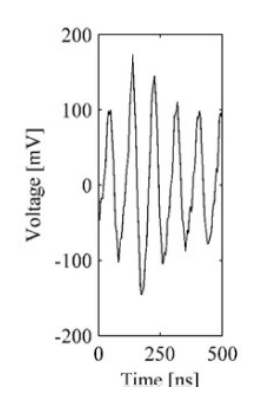
Power consumption (zoomed view)
- Power trace in 6 clock cycles
- Each peak -> 1 clock cycle
- Peaks are different
-> depends on operation
-> depends on data
Simple Power Analysis (SPA)
-> one powertrace is good enough to leak the secret
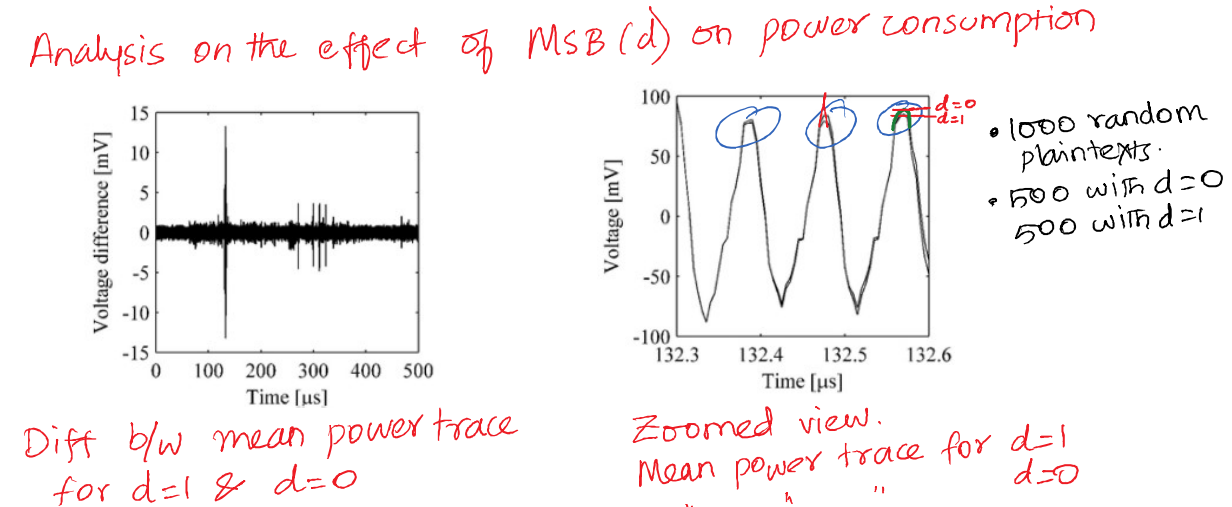
- Peaks reveal the moments of time
-> depends on the data
-> depends on the operation - Highest peak is at 132 μs
-> this is when the byte containing the MSB is loaded Power for d = 0 and d = 1 are almost the same except for 3 clock cycles
-> That’s the moment of interest
-> This is whe d or data related to d is processed
Can we exploit this? -> power analysisExample with key:
- Plaintext (p) is first XORed with roundkey (RO); let’s say Ro = k
- Substitution box is then performed
- Power consumption at some point
